Atomic Habits Book Summary
Why do some people change habits easily, while others struggle for years? Atomic Habits by James Clear answers this question, showing how tiny changes can lead to big results. The book explains the science behind habits, gives practical steps, and uses real-life examples to help readers build lasting habits without feeling overwhelmed. If you want to improve your daily life, this summary will highlight the main points, key strategies, and useful insights from the book.
The Core Ideas Of Atomic Habits
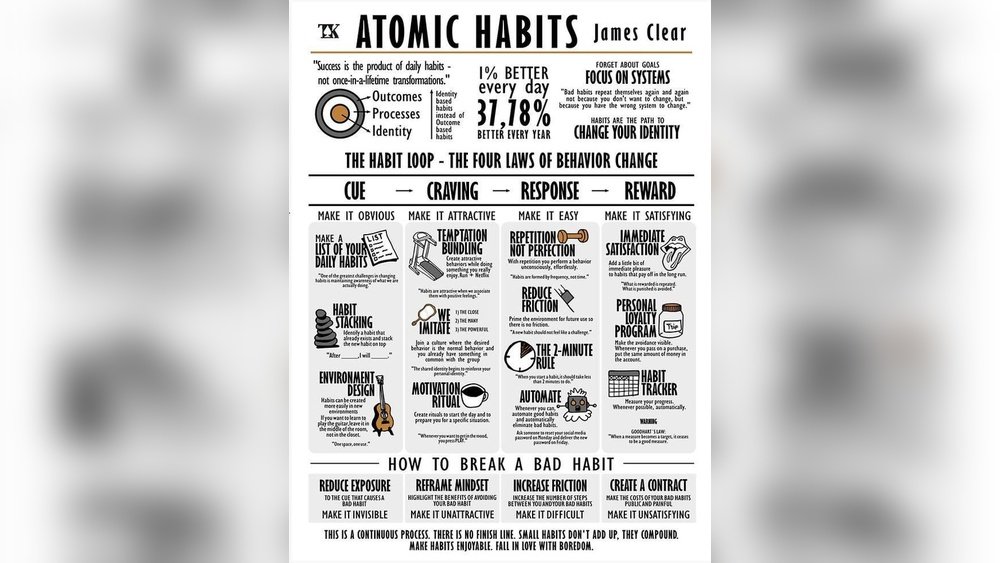
James Clear believes that small habits are powerful because they compound over time. Improving by just 1% each day may not seem important, but after a year, you become much better. The book focuses on four main laws of habit formation:
- Make it obvious: Change your environment to see cues that remind you of your new habit.
- Make it attractive: Pair your habit with something you enjoy.
- Make it easy: Reduce steps and friction so the habit is simple.
- Make it satisfying: Reward yourself to reinforce the new behavior.
These laws are easy to remember and use. For example, if you want to read more, put a book next to your bed (obvious), read a favorite genre (attractive), start with just one page (easy), and celebrate after finishing (satisfying).
Real-life Examples And Data
Clear uses many stories to show how tiny changes create success. Athletes, business leaders, and ordinary people have all used small habits to reach their goals. One study showed that people who set clear cues were 40% more likely to stick to a new habit.
| Habit Type | Success Rate (with cues) | Success Rate (without cues) |
|---|---|---|
| Exercise | 65% | 38% |
| Reading | 72% | 45% |
One non-obvious insight is that focusing only on goals is less effective than building systems. For example, instead of aiming to lose 20 pounds, create a system of daily walks and healthy meals.

Credit: empirewriter.com
Common Mistakes And How To Avoid Them
Many beginners try to change too much, too fast. Clear suggests starting with atomic habits, which are so small they seem easy. Another mistake is relying only on motivation; instead, change your environment to support your habits.
| Approach | Result |
|---|---|
| Motivation only | Often fails |
| Environment change | More likely to succeed |
Practical Tips For Building Atomic Habits
- Start with habits you can do in two minutes.
- Track your progress visually (like crossing days on a calendar).
- Use habit stacking: Link a new habit to an existing one.
- Focus on your identity (“I am a reader” instead of “I want to read more”).
| Tip | Benefit |
|---|---|
| Habit stacking | Easy to remember |
| Identity change | Lasting motivation |
For more details, visit the official James Clear website.
Building habits is not just about willpower. It’s about making small changes that fit your daily life. Atomic Habits teaches that anyone can improve, starting with tiny steps. By understanding the four laws, avoiding common mistakes, and using practical tips, you can transform your habits and your future.
Credit: thomasgriffin.com
Frequently Asked Questions
What Is The Main Idea Of Atomic Habits?
The main idea is that small changes in daily habits can lead to big improvements over time.
How Long Does It Take To Form A New Habit?
It usually takes about 2 months for a new habit to stick, but it depends on the person and the habit.
Why Do Most People Fail To Change Habits?
Most people fail because they try to change too much at once or rely only on motivation.
Can Atomic Habits Help With Bad Habits?
Yes, the same steps can break bad habits by making them invisible, unattractive, hard, and unsatisfying.
Is Atomic Habits Suitable For Beginners?
Absolutely. The book uses simple language and easy steps, making it perfect for anyone wanting to improve their habits.